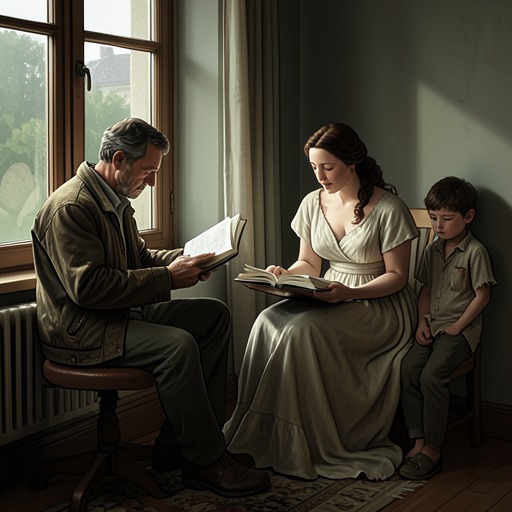
Books are mirrors: you only see in them what you already have inside you
The Shadow of the WindJulian Carax’s remark that books are mirrors is a compact account of reading as self-recognition: what a reader sees in a book depends on what is already present within that reader. Spoken to Jorge Aldaya, who dismisses books as boring, the aphorism also makes reading a matter of inward difference rather than universal taste.
The Remark in Context
Jorge says that books are boring after Julian asks whether he has read any of them. Julian answers that books are mirrors, then listens as Don Ricardo Aldaya leaves the two boys together and describes Jorge as spoiled and conceited, but not as stupid as he seems. The conversation shifts from books to the person judging them: Jorge’s dismissal becomes, in Julian’s formulation, evidence about the limits of what he is prepared to find in a book.
Image and Meaning
The mirror image makes reading reciprocal. A book does not simply deliver knowledge outward to a passive reader; it reflects inward, making the reader’s existing thoughts and feelings available to recognition. The aphorism therefore allows for different readings of the same book without claiming that the text itself is empty: the encounter varies because readers bring different inner lives to it.
The Moment’s Reversal
Julian’s answer is immediately shadowed by the exchange that follows. Don Ricardo’s praise of Jorge carries a painful implication, and his words seem to fall like knives on the boy. Jorge keeps smiling, but Julian regrets his own remark and feels sorry for him. The scene thus complicates the aphorism: a person’s outward mask may not disclose what lies within, even as books are said to reveal it. Julian’s regret also turns the maxim back on its speaker, suggesting that insight into others brings a responsibility to notice when words wound them.
Narrative Significance
The saying joins the novel’s concern with books to its attention to memory, character, and interpretation. Its brevity gives it the shape of a general rule, but its placement in a tense introduction to Jorge makes that rule personal and uncertain: reading may reveal what a reader carries, while social judgment can still mistake a mask for the person beneath it. The mirror is therefore not merely a metaphor for books; it is a way of framing the risks and limits of trying to understand another person.